
 Image 1 of 2
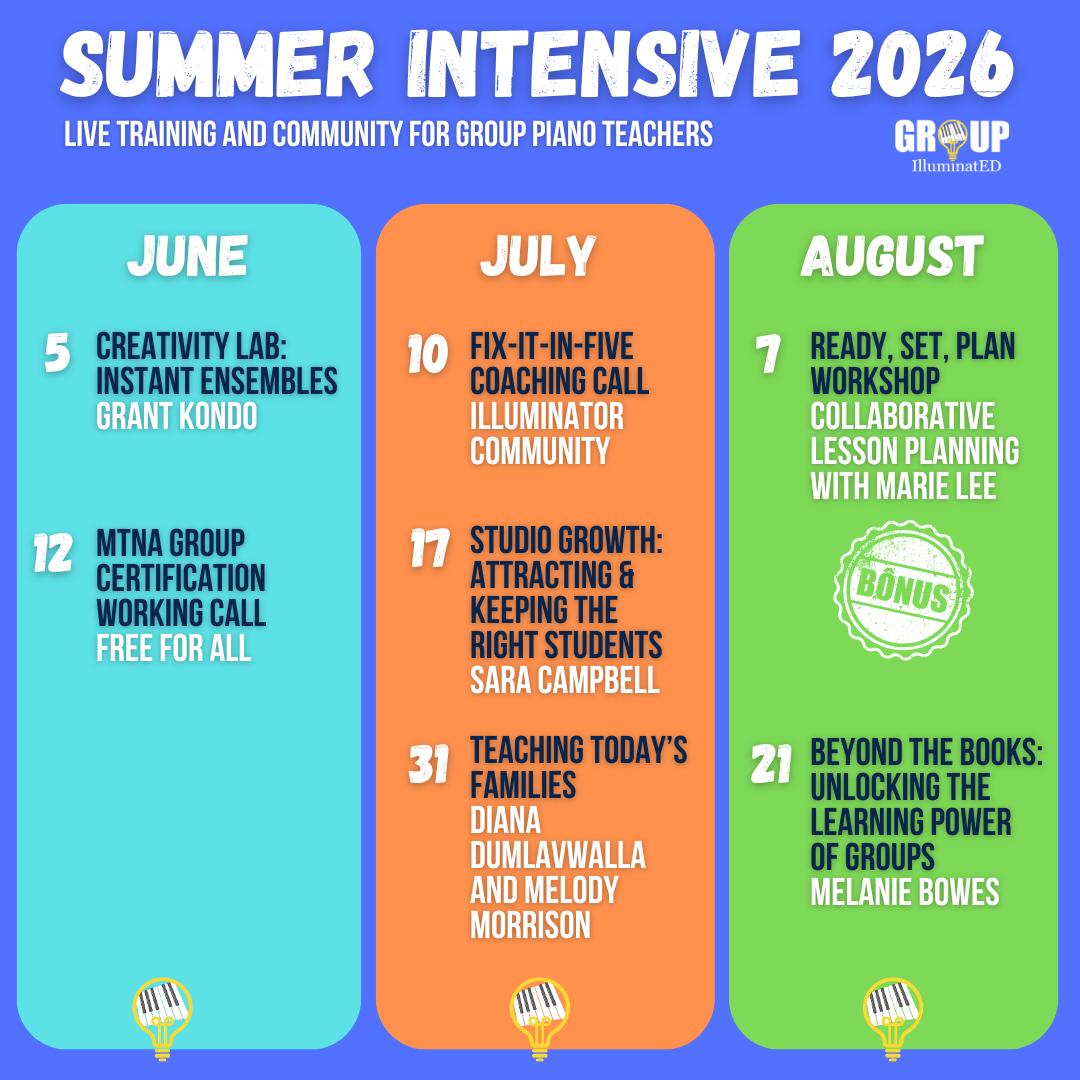 Image 2 of 2
💡Your Summer Sessions
🎹 Two Roles, Endless Possibilities: Improvising Melody & Accompaniment in Group Piano Classes By Grant Kondo
Create instant, multi-level ensemble music using melody and accompaniment. This hands-on, play-centered session puts you at the piano, learning strategies you can immediately use to build creative, collaborative group classes.
How do you get students of different levels making real music together—right away?
In group piano, one of the biggest challenges is balancing multiple levels while keeping every student engaged and musically involved.
This session offers a simple, powerful solution: two clearly defined roles—melody and accompaniment.
Start with Instant Music-Making
We begin with free improvisation, where students explore creating music in the moment using only these two roles.
Through guided, play-based activities, you’ll experience how even the simplest patterns can quickly become engaging, ensemble-driven music—no advanced skills required.
Bridge to Repertoire (Without Losing Engagement)
Next, you’ll learn how to carry this same framework directly into your teaching:
Transform basic patterns into supportive, musical accompaniments
Help students “level up” parts within existing duets
Adapt repertoire so every student can participate meaningfully
Add improvisation sections to bring music off the page
Go Beyond the Bench
This approach naturally expands into a richer group experience by incorporating:
Singing and lyrics for melodic interaction
Accessible instruments (drums, melodicas, etc.)
Backing tracks for a full ensemble feel
Why This Works in Group Piano
By assigning flexible roles instead of fixed parts, students can:
Contribute at their own level with confidence
Develop listening and ensemble awareness
Build creativity through structured improvisation
Stay engaged—because everyone is actively making music
Walk Away With Practical, Ready-to-Use Ideas
This is an active, play-centered session designed specifically for group piano teachers. Join on your piano and leave with simple strategies you can immediately implement to turn your classes into collaborative, creative music-making environments.
🌐 Beyond Word of Mouth: Smart Strategies for Recruitment and Retention By Sara Campbell
Discover practical ways to grow your group piano studio by improving your website visibility, using social media to build trust, attracting the right students, and strengthening retention through engaging class experiences and a strong studio community.
If you’ve ever felt like your studio growth depends on luck, referrals, or “hoping the right families find you”… you’re not alone.
👉 Word of mouth still matters—but it’s no longer enough on its own.
Today’s studios need a clear, intentional strategy that helps families:
✔ find you
✔ trust you
✔ say yes
✔ and stay
Inside This Course, You’ll Learn How To:
🎯 Use social media the right way
Not as your main marketing tool—but as a powerful way to build trust through real-life moments in your studio.
🌐 Make your website work for you
Simple, practical SEO strategies so families can actually find you when they search for lessons in your area.
🎹 Get students in the door
Design a first lesson experience that feels so engaging and musical, enrollment becomes the natural next step.
💛 Create a studio students don’t want to leave
Through performances, community, progress systems, and meaningful experiences that go far beyond weekly lessons.
The Result?
A studio that is:
✨ easy to find
✨ compelling to join
✨ and meaningful to stay
Sustainable growth doesn’t come from doing more marketing…It comes from aligning your visibility, experience, and retention.
👨👩👧👦 The Modern Family Playbook: Rethinking Parent Support for Today’s Piano Students By Drs Diana Dumlavwalla and Melody Morrison
Support today’s busy families without adding more to their plate. Discover practical ways to strengthen the student–teacher–parent connection using simple systems, clear communication, and modern tools that keep group piano students progressing between classes.
The student–teacher–parent triangle still matters…
…but the reality of family life has changed.
Today’s families are juggling full schedules, multiple activities, and constant demands on their time. Even the most supportive parents can feel overwhelmed—which often shows up as inconsistent practice, miscommunication, or frustration at home.
And in group piano settings, this challenge is even more real.
When you’re teaching multiple students at once, you can’t rely on constant one-on-one parent support to fill in the gaps. Instead, you need clear systems, strong communication, and learning structures that help every student move forward—no matter what support looks like at home.
So how do we support students… without asking parents to do more?
In this session, you’ll learn how to adapt the student–teacher–parent relationship for modern group piano teaching—so students stay engaged, families feel supported, and progress continues between classes.
Learn how to:
✔ Support consistent practice between group classes in realistic, sustainable ways
✔ Strengthen communication with busy families—without chasing them down
✔ Build student independence so progress doesn’t depend on parent involvement
✔ Keep all students in your group classes engaged—even when support at home varies
✔ Create simple systems that reduce overwhelm for both you and your families
Strategies you can use right away:
• Short, targeted video practice guides families will actually use
• Auto-text reminders and streamlined communication systems
• Simple, curated tech tools that support (not complicate) your studio
• Backing tracks and play-along tools that build student independence
• Visual progress systems (maps, trackers, milestones) that motivate
• Gamified micro-goals that turn small wins into long-term progress
Why this matters
The student–teacher–parent relationship isn’t outdated—it just needs to evolve.
In group teaching, we can’t rely on parents to fill in the gaps.
We need systems that support every student, every week, within the structure of the class.
When you shift your approach, you create:
✨ More consistent progress across your entire group
✨ Less stress and guilt for parents
✨ More independent, confident students
✨ Stronger retention and long-term engagement
The result?
Students who keep moving forward—even between classes.
Parents who feel supported (not overwhelmed).
And group piano classes that work with modern family life—not against it.
📚 Beyond the Books: Unlocking the Power of Group Learning By Melanie Bowes
In group piano, differentiation is about far more than assigning different repertoire levels. This session explores how questioning, peer interaction, discussion, and collaborative learning can deepen musical understanding while helping students become more independent, engaged musicians.
Stop trying to teach every student individually inside a group class — and start using the power of the group itself.
Many teachers assume differentiation in group piano means giving students different songs, levels, or assignments. But true differentiation goes much deeper than repertoire.
In this thought-provoking and practical session, Dr. Melanie Bowes explores how group learning environments can actually create stronger musical understanding, independence, and engagement when teachers intentionally use discussion, questioning, collaboration, and peer learning as teaching tools.
You’ll discover ways to move beyond “keeping everyone busy” and instead create group classes where students actively think, respond, interact, and learn with each other.
This session will help you rethink:
How students process and understand musical concepts
Why peer interaction strengthens learning and confidence
The teacher’s role as facilitator instead of constant problem-solver
How questioning strategies build more independent musicians
Ways to encourage discussion, listening, and musical decision-making inside group classes
How collaborative learning can deepen engagement across varying ages and abilities
Perfect for teachers who:
✔ Want group classes to feel more musical and interactive
✔ Struggle with balancing multiple learning styles and abilities
✔ Want students to think more independently instead of relying on constant teacher feedback
✔ Are looking for deeper learning beyond simply “getting through the method book”
✔ Want practical teaching ideas grounded in modern pedagogy and real group teaching experience
Whether you teach beginners or advanced students, this session will give you fresh ways to use the group dynamic itself as one of your greatest teaching tools.